he Allianz Arena clock had barely ticked past twenty minutes when Bayern vs Paris turned into a case study of pressing triggers. Leroy Sané cut inside from the right, not to shoot, but to slide a pass behind Achraf Hakimi. That single action exposed Paris’s recurring problem: their full-backs push high。but the midfield screen lags. I counted three similar situations before half-time. Each time, Bayern’s left side overloaded Paris’s right, forcing Marquinhos to cover wide and leaving a canyon between him and Sergio Ramos. It wasn’t chaotic. It was surgical.
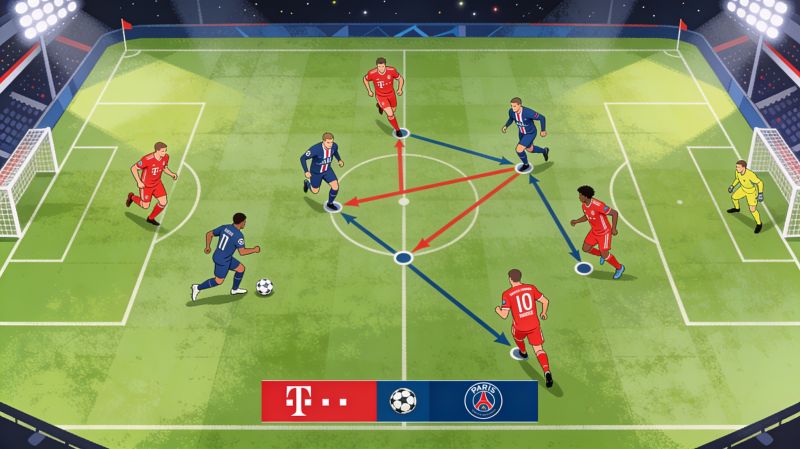
Possession stats rarely tell the whole story. Bayern vs Paris ended with a near-even split。yet the shot quality gap was obvious from the stands. Paris’s best chances came from individual bursts—Mbappé’s acceleration, Messi’s sudden through-ball—while Bayern’s arrived from structured sequences. A fifth-minute corner routine, for example: Kimmich’s near-post delivery flicked on by Goretzka, forcing Donnarumma into a reflex save. That kind of rehearsed pattern separates a team that trains set pieces weekly from one that relies on improvisation. Julian Nagelsmann’s side won the second balls relentlessly. Paris, by contrast, looked like a collection of brilliant musicians without a conductor, which is fine in Ligue 1 but punishing in Munich.Midfield control decided this Bayern vs Paris encounter more than any individual duel. Joshua Kimmich and Leon Goretzka rotated constantly—one dropping deep, the other pushing into the half-space—dragging Marco Verratti and Danilo Pereira out of position. I noticed Verratti gesturing angrily toward the bench around the hour mark, frustrated by the lack of compactness. Paris’s response was to drop deeper, but that only invited pressure. Bayern’s second goal came from a recycled corner: Müller’s short pass to Sané, a whipped cross。and Choupo-Moting’s header. Ugly?Maybe. Effective?Absolutely. Paris had no equivalent mechanism for grinding out goals when the counterattack wasn’t on.
Late in the game, Paris switched to a back three and pushed Hakimi and Nuno Mendes higher. It nearly worked—Mbappé hit the post after a quick exchange with Neymar. But Bayern’s experience showed in how they killed the tempo: small fouls, slow throw-ins, a tactical substitution that broke Paris’s rhythm. The Bayern vs Paris narrative often centers on star power, yet the decisive margins were boring: better rest-defense, sharper set-piece routines, and a midfield that knew when to foul. Paris has the talent to win this fixture in a rematch, but only if they trade some flair for structure. Otherwise。nights like this will keep repeating.